17 October 2008

Center Stage at Selby

By John R. Clark

An important goal we have at the GRC is increased visibility of gesneriads at Selby Gardens. The Tropical Plant Display House provides a wonderful venue to do so: inside, one can walk among many great specimens of tropical plants including various orchids, bromeliads, and gesneriads. There are currently several gesneriads to see in the Display House, both prominently featured as well as nestled into the naturalistic displays.

Upon entering the Display House, visitors can stroll along a winding path that takes them to a running waterfall and stream. The path is bordered by several gesneriads including species of Episcia, one Columnea sanguinea, and a specimen of Drymonia coriacea from Panama. If you look up and over the waterfall you will see a massive specimen of the same Drymonia; this individual, several meters long and branched many times, serves as a shade cover for plants below.

Also near the waterfall is a large specimen of  Rhynchoglossum azureum. This genus of gesneriad is unusual in many respects including the alternate (not opposite) leaves and strongly labiate, blue and white corollas. 
Rhinchoglossum is also unusual in it's distribution: although a member of the Old World subfamily Cyrtandriodeae, species of Rhynchoglossum are found in both the Old and New World tropics. This "disjunct" distribution may be indicative of a geologically recent introduction of the genus to tropical America from Asia.

As vistors wander past the waterfall they arrive at the Display House's "center stage." Hanging in all it's full glory is a great specimen of Drymonia pendula from Peru. This spectacular plant was originally collected by Bruce Holst on a Selby Gardens expedition. The plant's characteristic pendulous, red infloresences are unmistakable.


Selby Gardens' Display House offers visitors is a fantastic glimpse into the wonderful world of tropical plant diversity. Many of the plants featured in the Display House were collected by Selby Gardens botanists over the last 35 years. These valuable and often irreplaceable collections are skillfully maintained by the Gardens' horticulture staff, led by Mike Mclaughlin, Director of Horticulture at Selby Gardens 
and Angel Lara, Selby's Greenhouse Manager. Selby staff that most often work with gesneriads includes Gail McDaniel (Collections Horticulturalist) and Angela Weber (Display House Horticulturalist and newest staff member at Selby). We at the GRC are looking forward to working with Mike, Angel, Gail and Angela, as well as numerous dedicated volunteers, to continue making gesneriads visible at the Gardens and to promote awareness of this horticulturally and scientifically important family of plants.


15 October 2008

You have entered "The Interface Zone"


The Interface Zone: solid line indicates an area known as the "Fijian Region." The "Interface Zone" includes all of the Fijian Region plus the area enclosed by the dashed line (Fig. 1 from Clark, J.R. 2008. Gesneriads at the edge of the world...with notes on current research at Selby Gardens. Gesneriads 58: 35-38).

By John R. Clark

By now, many Gesneriad Society Members have received the newest issue of Gesneriads. On page 35 there is an article on our signature research project at the GRC: Gesneriads of the Interface Zone. We are in the process of securing funding for this project through competitive grants and philanthropic individuals. If you or someone you know may be interested in participating or supporting us in this monumental project, please contact me.

Okay...here's a bit of an overview of what we are planning to do (just in case some of our blog readers don't receive Gesneriads):

Comparative study between related lineages of organisms that differ in their ability to colonize islands can provide valuable insight into how geography may be affecting speciation. The flowering plant family Gesneriaceae (African violets and their relatives) provides a unique opportunity to examine island colonization in relation to the evolution of species: although gesneriads are found distributed throughout all of the world’s tropical forests, only one genus, Cyrtandra, has colonized the remote Pacific Islands. Cyrtandra is the most species-rich genus of gesneriad (>500 species) and has the greatest single range for any genus in the family, extending from the Nicobar Islands in the Indian Ocean to the distant Hawaiian and Marquesan Islands in the Pacific. The broad distribution and large number of species in Cyrtandra is in marked contrast to other gesneriads, including the genera Aeschynanthus (±185 sp.), Boea (±14 sp.), Coronanthera (±11 sp.)and Epithema (±20 sp.), that reach their easternmost extent in the Solomon Islands. For these gesneriads, the southeast Asia-Pacific Interface Zone is effectively the “edge of the world.”

The Interface Zone, centered on Fiji and including the Solomon Islands, Vanuatu, New Caledonia, Tonga, and Samoa (as well as other associated islands), has been implicated as a center of origin for the Pacific species of Cyrtandra (Clark, J.R. et al. 2008. Syst. Biol. 57:693-707). Results from these evolutionary analyses suggest that once the barrier to Pacific dispersal within the Interface Zone had been overcome, Cyrtandra was well suited for island hopping and continued to do so across the expanse of the Pacific. As intriguing as this scenario is, the data supporting it are preliminary and additional species sampling and further analyses are required. Likewise, the other genera of gesneriads from the interface zone are poorly known and similar evolutionary analyses have not been conducted as a result. Intensive species sampling within the interface zone, principally in the Solomon Islands and Fiji, is vital to address the questions of how and why Cyrtandra dispersed throughout the Pacific while a diverse assemblage of related gesneriads did not.

In collaboration with representatives from the Solomon Islands and Fiji, we are proposing detailed sampling and collection of the gesneriads Aeschynanthus, Boea, Coronanthera, Cyrtandra and Epithema in critical areas of the Solomon Islands (the islands of Guadalcanal, New Georgia, Santa Isabel, Choiseul) and Fiji (the islands of Viti Levu, Vanua Levu, and Taveuni) beginning in July of 2009. The Solomon Islands represents the easternmost range for all genera under consideration, excluding Cyrtandra, and Fiji is the hypothesized first step into the Pacific by Cyrtandra. Data to be collected include herbarium specimens, silica gel-dried leaf tissue, alcohol-preserved flowers and fruits, living collections, and locality/habitat information. This fieldwork will be critical for completing comprehensive evolutionary studies on these genera and are required for detailed analysis and testing of the center of origin hypothesis for Cyrtandra as well as for developing parallel hypotheses in related gesneriad genera.

Stay tuned to the GRC blog for updates on this and other exciting projects involving gesneriad research at Selby Gardens.

05 October 2008

Subscribing made easy.

By request, I have added a new feature to the GRC blog: e-mail subscriptions!

It's fast and easy: enter your email address in the space provided (to the right) and click "subscribe." A confirmation email will then be sent to you by FeedBurner asking you to confirm your subscription. Click on the link and you are all set.

Good news: you only get updates when there are changes/additions to the GRC blog (generally twice a week or less). As expected, you can unsubscribe at any time.

~ John

29 September 2008

Suncoast-Tampa Bay show a success

By John R. Clark

On September 20-21, 2008, the Suncoast and Tampa Bay Chapters of The Gesneriad Society jointly held a show and sale at the Marie Selby Botanical Gardens. By all accounts the show was a success, due in no small part to the dedication and support of the Tampa Bay Chapter and their willingness to support our efforts in Sarasota.
The show had 119 entries, including award-winning plants, artistic designs/plantings, and arts entries. Best in Show went to Jo Anne Martinez for her spectacular Gesneria 'Ako Cardinal Flight'. Sweepstakes in Horticulture went to Nancy Kast for her nine blue ribbon-winning entries.

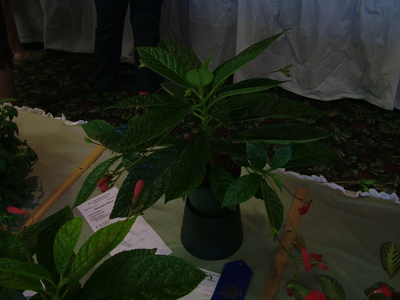
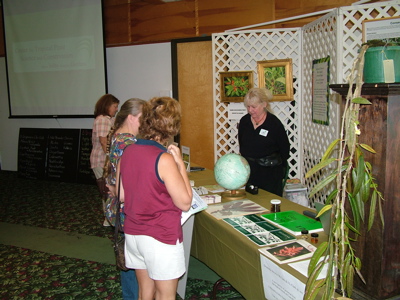
The new GRC was prominently featured at the show alongside Karen Schunk, who maintained an exhibit of her fantastic botanical watercolor paintings and prints. Karen, a Selby Research Assistant, volunteer and supporter, helped field questions about gesneriad research and Selby Gardens (while I was out taking photographs!).

The show generated a great deal of interest in gesneriads at the Gardens and an increased number of visitors came through the gates owing to the show and sale. The show was a particularly great opportunity for us at the GRC to promote our efforts and mission. Thanks to all who participated!


11 September 2008

Gearing up at the GRC!

By John R. Clark

Fellow gesneriad enthusiasts! We are finally here - the Gesneriad Research Center is open for research...at Selby Gardens. Not even two weeks in and we have several projects off the ground: we are moving forward with research, gesneriad promotion, an upcoming regional show and sale, and more. Let me take a few moments to tell you about some of these exciting developments.

Gesneriad Show and Sale. First off, Selby Gardens will be the site of the upcoming gesneriad show, "The ABC's of Gesneriads", co-hosted by the Tampa Bay and Suncoast Chapters of The Gesneriad Society. The show is this coming September 20-21 in Selby's Great Room by the Bay. The event promises to be a fantastic one with entries arriving from all over Florida along with several guest judges visiting from out of town. We are all excited to have a large contingent of gesneriad folks here at Selby for this event. For more information, check out Selby's upcoming events list at www.selby.org

Promoting gesneriads. One of the principal goals of the GRC is to promote gesneriads at Selby Gardens and elsewhere. To this end, we are working with Debbie Steele, Selby Gardens Public Relations Director, to design and publish a brochure featuring the GRC. Similarly, Donna Krabill, Director of Education at Selby (and a member of The Gesneriad Society!) is collaborating with Selby Research to design an education cart that will feature gesneriad and other research at Selby. This cart will be positioned out in the Gardens and staffed by knowledgeable volunteers. More on these efforts in the coming weeks!

Research updates:

New species of Drymonia. I, in collaboration with the other John Clark (John L. at the University of Alabama), have recently submitted papers describing two new species of Drymonia. These species, one from Costa Rica and the other from Ecuador, exhibit the variety of characters and form that can be found in this interesting genus. 


Drymonia sp. nov. is characterized by dense clusters of flowers with bright orange, pouched corollas. The other Drymonia sp. nov. has more or less typical Drymonia flowers but is unique in having a graceful, pendulous habit. 


Hawaiian Cyrtandra. In collaboration with Warren L. Wagner and Eric H. Roalson, I am working to complete a Monograph of Hawaiian Cyrtandra. Hawaiian species of Cyrtandra are quite diverse and have been historically difficult to classify. This monograph is the result of years of effort and will be a major milestone towards understanding this genus. As part of this work, Dr. Doug Rist, a retired surgeon, has begun volunteering at Selby for the GRC. Doug's job is to glean distribution data from an existing database on Hawaiian Cyrtandra specimens and use this information to construct detailed distribution data for the monograph. This painstaking process will be vital to making the monograph a valuable reference for years to come. On behalf of the GRC, I'd like to welcome Doug on board! I'd also like to welcome him to The Gesneriad Society - Doug's now a member!

Also related to this, Melissa McDowell (long-time Society member and Selby volunteer) is now working to compile a comprehensive file of Cyrtandra publications. Having a consolidated library of Cyrtandra literature will be indispensable as we continue the daunting task of understanding the diversity of this large genus (the largest in the Gesneriaceae). Since there are over 600 recognized species of Cyrtandra, and more than twice that number of named species, this new project is going to keep Melissa busy for quite some time. Thanks, Melissa!

(Above, a picture of a Cyrtandra richii from Samoa)

Believe it or not, there is actually more to tell, but I will save that for an upcoming installment. Check back soon for more updates, highlights from next week's gesneriad show and more!

09 September 2008

Why is the GRC at Selby Gardens?

By John R. Clark and Bruce K. Holst

Contemporary gesneriad research in North America had its roots in the early 1970s, and the Marie Selby Botanical Gardens (est. 1973) played a significant role. The importance of gesneriads at Selby Gardens is evident from the Gardens’ seal that illustrated a bromeliad, an orchid, and a gesneriad. Hans Wiehler was the driving force behind Selby’s early gesneriad program, helping to build the living and preserved collections during his tenure there. After leaving Selby Gardens in the early 1980s, Wiehler created the Gesneriad Research Foundation (also in Sarasota, Florida) to continue his work on the family while Selby Gardens focused its efforts on bromeliads and orchids. Simultaneously, Larry Skog, a leading gesneriad authority and contemporary of Wiehler’s, was furthering gesneriad research at the Smithsonian Institution, a legacy first established by Conrad Morton in the 1930s. During the last two decades of the 20th century, Wiehler’s Gesneriad Research Foundation and Skog’s efforts at the Smithsonian were key in furthering our knowledge of the family.

In 2002, with his health failing, Hans Wiehler made the decision to donate the several thousand herbarium specimens of the Gesneriad Research Foundation (GRF) to Selby Gardens. The GRF’s collection of liquid-preserved specimens would soon follow. These specimens had been accumulated through numerous field trips over a nearly 30-year period (1971-1999), and represent the most significant collection of gesneriads made by a single individual. Larry Skog was enlisted to assist in the consolidation of the specimens into the Selby Herbarium. Contributing to this effort were Jeanne Katzenstein (Editor of Gesneriads, the journal of The Gesneriad Society), Bruce Holst (Selby Gardens Herbarium Curator), John R. Clark (now director of gesneriad programs at Selby), Melissa McDowell (Suncoast Chapter of The Gesneriad Society), and many dedicated volunteers.

Meanwhile, Skog was nearing the end of his industrious career at the Smithsonian; retiring in 2003. The venerable institution would not be continuing gesneriad research in an official capacity after his retirement, thus leaving a need for a centralized research program. With its newly acquired GRF collections and existing resources, it was clear to all involved that Selby Gardens was an excellent choice to host a center specializing in gesneriads.

What is the role of the GRC Director?

Here it is, straight from the job description: 

The Research Systematist will oversee the development and daily operations of the Center for Tropical Plant Science and Conservation’s newly formed Molecular Research Facility and Gesneriad Research Center, in conjunction with other research staff, volunteers, outside collaborators and interns. He will report to the Director of the Center for Tropical Plant Science and Conservation. The Research Systematist will coordinate activities to develop and implement the Molecular Research Facility by writing funding proposals and securing donations to equip the facility and to conduct molecular-based research. The Research Systematist will be responsible for timely completion of project objectives, manage project expenditures, assist in development of molecular-based and gesneriad research programs and prepare reports and publications on project accomplishments. The Research Systematist will participate in education and outreach activities, particularly in conjunction with local, national, and international gesneriad societies, serve as the Center's contact for molecular and gesneriad research, and supervise training of volunteer assistants and interns.

In addition, the Systematist will conduct research geared towards enhancing the Garden’s research mission. This research will include basic field research and plant collecting, as well as molecular-based and traditional taxonomic/monographic research with emphasis in the plant family Gesneriaceae and secondarily with other plant families under study at the Center.